Sunday, 29 January 2017

Topic 2: Inequalities & Exercise

INEQUALITIES

Definition of inequalities
An inequality says that two values are not equal. a ≠ b says that a is not equal to b. There are other special symbols that show in what way things are not equal.
   
Inequalities tells us about the relative size of two values. Mathematics is not always about "equal" but sometimes we only know that somethings is "bigger or smaller".
 -.
Rule of Inequalities

1) a < b means a is a smaller number than b.
2) a ≤ b means a is a smaller number than b or they are equal.
3) a > b means a is a larger number than b.
4) a ≥ b means a is a larger number than b or they are equal.


Important thing!!! ๐Ÿ‘‡


Example 1: 

3x < 7+3
We can simplify 7 + 3 without affecting the inequality:
3x < 10
But these things change the direction of the inequality ("<"becomes"> "for example):
  • Multiply (or divide) both sides by a negative number
  • Swapping left and right hand sides

Example 2:

2y + 7 < 12
When we swap the left and right hand sides, we must also change the direction of the inequality:
12 > 2y + 7


Example 3:

Solve: 2x + 3 ≤ 15

Solution: 2x ≤ 15 - 3

why its (-3) because in front the number 3 is (+) so if the sign bring to backwards it's become (-) sign. 

2x ≤ 12
x ≤ 12/2
x ≤ 6


Adding or Subtraction a value

We can often solve inequalities by adding (or subtracting) a number from both sides (just as in introduction on algebra), like this:


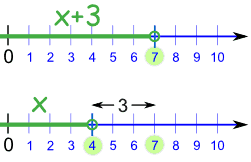
Solve: x + 3 < 7

If we subtract 3 from both sides, we get:

x + 3 - 3 < 7 - 3    

x < 4
And that is our solution: x < 4
In other words, x can be any value less than 4. 

What did we do?

We went from this:

To this:
number line inequality x+3 < 7
x+3 < 7

x < 4
And that works well for adding and subtracting, because if we add (or subtract) the same amount from both sides, it does not affect the inequality.


What If I Solve It, But "x" Is On The Right?

No matter, just swap sides, but reverse the sign so it still "points at" the correct value!
Example: 12 < x + 5
If we subtract 5 from both sides, we get:
12 - 5 < x + 5 - 5    
7 < x
That is a solution!
But it is normal to put "x" on the left hand side ...
... so let us flip sides (and the inequality sign!):
x > 7
Do you see how the inequality sign still "points at" the smaller value (7) ?
And that is our solution: x > 7
Note: "x" can be on the right, but people usually like to see it on the left hand side. 

Multiplying or Dividing by a Value

Another thing we do is multiply or divide both sides by a value (just as in Algebra - Multiplying).
But we need to be a bit more careful (as you will see).

Positive Values

Everything is fine if we want to multiply or divide by a positive number:


Solve 1: 3y < 15

If we divide both sides by 3 we get:

3y/3 < 15/3
y < 5
And that is our solution: y < 5

Example 1:

Solve 2: -2y < -8


Let us divide both sides by -2 ... and reverse the inequality!
-2y < -8
-2y/-2 > -8/-2
y > 4
And that is the correct solution: y > 4

(Note that I reversed the inequality on the same line I divided by the negative number.)
 
So, just remember:

*When multiplying or dividing by a negative number, reverse the inequality


Multiplying or Dividing by Variables

Here is another (tricky!) example:

Solve 1: bx < 3b

It seems easy just to divide both sides by b, which gives us:
x < 3
... but wait ... if b is negative we need to reverse the inequality like this:
x > 3
But we don't know if b is positive or negative, so we can't answer this one!
To help you understand, imagine replacing b with 1 or -1 in the example of bx < 3b:

  • if b is 1, then the answer is x < 3
  • but if b is -1, then we are solving -x < -3, and the answer is x > 3
The answer could be x < 3 or x > 3 and we can't choose because we don't know b.
So:
Do not try dividing by a variable to solve an inequality (unless you know the variable is always positive, or always negative).

A Bigger Example

Solve: (x-3)/2 < -5

First, let us clear out the "/2" by multiplying both sides by 2.
Because we are multiplying by a positive number, the inequalities will not change.

(x-3)/2 ×2 < -5 ×2  
(x-3) < -10

Now add 3 to both sides:

x-3 + 3 < -10 + 3    
x < -7
And that is our solution: x < -7

Two Inequalities At Once!

How do we solve something with two inequalities at once?

Solve:


-2 < (6-2x)/3 < 4
First, let us clear out the "/3" by multiplying each part by 3:
Because we are multiplying by a positive number, the inequalities will not change.

-6 < 6-2x < 12

Now subtract 6 from each part:

-12 < -2x < 6

Now multiply each part by -(1/2).

Because we are multiplying by a negative number, the inequalities change direction.
6 > x > -3
 And that is the solution!

But to be neat it is better to have the smaller number on the left, larger on the right. So let us swap them over (and make sure the inequalities point correctly):

-3 < x < 6


Below is the video to show you how to solve the inequalities

Exercise

1) solve the inequalities: 2 + 6x < 4


2) 8 - 2x > 2


3) Ali has $10, while Azman has only $3. how do you do the sign?

Sunday, 22 January 2017

Topic 7: Probability & Exercise

PROBABILITY

 Definition of probability..

- Probability is a branch of mathematics that deals with calculating the likelihood of a given event's occurrences which is expressed as a number between 1 and 0. An event with a probability of 1 can be considered a certainty while an event with a probability of 0 can be considered an impossibility.
 
Calculating probabilities in a situation like a coin toss is straightforward, because the outcomes are mutually exclusive, either one event or the must occur. Each coin toss is an independent event. The outcome of one trial has no effect on subsequent ones. 


STEP TO FIND THE PROBABILITY 

STEP 1: LIST THE OUTCOME OF EXPERIMENT

STEP 2: COUNT THE NUMBER OF POSSIBLE OUTCOME OF THE EXPERIMENT

STEP 3: COUNT THE NUMBER OF FAVORABLE OUTCOMES 

STEP 4: USE THE PROBABILITY FORMULA.

Formula to find probability
p (a) = number of favorable outcomes / total number of possible outcomes


Example 1:

In a restaurant 40% of the male customers choose chicken for their main course. if a male customers choose chicken, the probability that he will choose ice cream to follow is 0.6 if he does not have a chicken the probability that he will choose ice cream is 0.3

complete the tree diagram to illustrate this information.

a) chicken and ice cream?

p (c & i) = p (0 x p(i)

= 0.4 x 0.6

= 0.24


b) ice cream only

p (c) = p (c) x p (1)

= 0.18


Example 2:

Box a contains 3 coins numbered 3, 5 and 7. Box b contains coins numbered 4, 6 and 8 respectively A coin is drawn randomly from box A and another coin is drawn from the box B. 

a)from the above,

i) 7 

solution:

= P( 3&4)

= 1/3 X 1/3

=1/9 


II) 13

solution:

(1/3 + 1/3) x (1/3 + 1/3)

= 2/9 x 2/9

= 4 / 81


Example 3:

A man goes to work either by bus. The probability of bring late for works is 0.6 if he travals in two successive days.

a) find the probability that he will be late 

i) (L & L1)  
0.6 X 0.6
=0.36 

II) On exactly one of the two days
(L & L1) or (L1 & L)
(0.6 X 0.4) + (0.4 X 0.6)
0.24 + 0.24
= 0.48   

This is an example video of solving the probability. Let's learn from this video ๐Ÿ˜€


 Exercise

1) A glass jar contain 6 red, 5 green, 8 blue and 3 yellow marbles. if a single marble is chosen at random from the jar, what is the probability of choosing a red marble? a green marble? a blue marble? a blue marble? a yellow marble? 


 2) A single 6 sided die is rolled. what is the probability of each outcome? what is the probability of rolling an even number? of rolling an odd number?


  3) A number from 1 to 11 is chosen at random. What is the probability of choosing an odd number?

a) 1 / 11

b) 5 / 11

c) 6 / 11

d) None of the above 
 

Monday, 16 January 2017

Topic 3: Logarithms & Exercise

LOGARITHMS

Definition of Logarithms
Logarithms are the "opposite" of  exponential just as subtraction is the opposite if addition and division is the opposite of multiplication. Logs "undo" exponential. Technically speaking, log are the inverses of exponential.

In mathematics, the logarithms is the operation to exponential. That's mean the logarithms of a number is the exponent to which another fixed number, the base must be raised to product that number. In simple cases the logarithms of 1000 is 3, as 10 to the power 3 is 1000 (1000 = 10 x 10 x 10 = 10 base of 3).

When asked to solved a logarithmic equation such as Log2 (5x + 7) = 5 or log3 (7x + 3 ) = log3 (5x + 9). The first things we need ti decide is how to solve the logarithms while others are solved by rewriting the logarithms problem in exponential form. How do we decide what is the correct way to solve a logarithm problem? The key is to look at the problem and decide if the problem contains only logarithms or if the problem has terms without logarithms. So the correct way how to solve these type of logarithmic problems is to simply drop the logarithms.

Formula and laws of Logarithms

  • Product rule : logbAC = logbA + logbC
  • Quotient rule:  logb(A/C) = logbA − logbC
  • Power rule:  logbAC = C(logbA)

Basic example of log is:

The logarithm of x to base b, denoted log b (x), is the unique real number y such by = x.


Equivalent

Example 1:
How many 2s do we multiply to get 8?

Solution: Answer: 2 × 2 × 2 = 8, so we had to multiply 3 of the 2s to get 8
So the logarithm is 3


Example 2: 
What is log5(625) ... ?
We are asking "how many 5s need to be multiplied together to get 625?"


Solution: 5 × 5 × 5 × 5 = 625, so we need 4 of the 5s
Answer: log5(625) = 4

Example 3:
What is log2 (64)??

We are asking "how many 2s need to be multiplied together to get 64"?

Solution:
2 x 2 x 2 x 2 x 2 x 2 = 64, so we need 6 of the 2s
Log 2 (64) = 6

Exponents 

Exponents and Logarithms are related, let's find out how ...


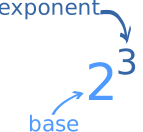
2 cubedThe exponent says how many times to use the number in a multiplication.
In this example: 23 = 2 × 2 × 2 = 8
(2 is used 3 times in a multiplication to get 8)

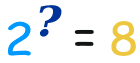
So a logarithm answers a question like this:

2 with what exponent = 8


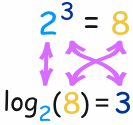
In this way:

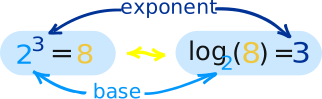
2^3=8 becomes log_2(8)=3


The logarithm tells us what the exponent is!

In that example the "base" is 2 and the "exponent" is 3:
2^3=8 becomes log_2(8)=3

So the logarithm answers the question:


What exponent do we need
(for one number to become another number)
?

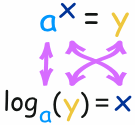
The general case is:
a^x=y becomes log_a(y)=x


Example 1:
What is log10 (100)?

Solution:
so an exponent of 2 is needed to make 10 into 100. 
so, the answer is log 10 (100) = 2

Example 2:
What is log3 (81)??

Solution:
3x = 81
3 ^ 4 = 81

So an exponent of 4 is needed to make 3 into 81. So the answer is log3 (81) = 4 

Example 3:
What is log6 (36)??

Solution:

6 ^ 2 = 36

So an exponent of 2 is needed to make 6 into 36, the answer is log6 36 = 2


OR ๐Ÿ‘‡

  (Logarithm form)

Example

Become
1)   16 = 24
1)   Log2 16 = 4
2)   64 = 82
2)   Log8 64 = 2


  (Exponent form)

Example

Become
1)   Log 3 27 = 3
1)   27 = 33
2)   Log9 81 = 2
2)   81 = 92


Saturday, 14 January 2017

Topic 1: Indices & Exercise

INDICES

       Introduction of indices
Indices are useful way of more simply expressing large numbers. They also present us with many useful properties for manipulating them using what are called "Law of indices"

What is indices?
Indices actually explain how many copies of the base number are multiplied. For instance, a base to the second power is referred to as the base squared and indicate that the base is multiplied by itself once.

The rules include the concept that any number other than 0 is always to 1 if it is index or exponent is o. Another rule holds that to divide mathematical expressions that have the same base, it is necessary to copy the base and subtract exponents.  

The picture below shows us that we should not forget that every number that is given it has a character of its own.  ๐Ÿ‘‰


Below is the rule of indices


Now you know the rule already, so i will give you some example how to do with the indices and how to solve the exercise later. let's learn together ๐Ÿ˜


Example 1:

Question: Find the 72 + 70


Solution:
= 49 + 1

= 50

*Why it is 50? because if the sign are given is (+) we must find through the base and no need to change the (+) sign to the multiply sign. If the sign are given is (x) so it can be solved directly.

Example 2:
Question: Find the values of the unknown in the following equations
a)  100x = 1

solution: refer to the rule above 
= 0

b) 52
= 5x5         

=25  (use rule number 1)

5 x 5 is also known as the expended form or factor form of 25 is known as index form. Generally when a number is multiplied by itself any number of times, the expression is simplified by using the index notation. 

Example 3:
Question: Find the value of  32 x 32

Solution:

= 32+2

= 34


Below is the video that show us how to solve the question with the rule that are given above.


If you are confuse with the sign, don't be panic just refer to the rule that are given above, it can help you to solve it.Hopefully with the 3 example that are given can help you to understand more and can solve the exercise below๐Ÿ˜€

Now, you have learn the important rules of indices, so are you ready to try the exercise below? let's try it


Activity!!
..............Lets solve it...........

1) Mn ÷ Nm


2) 33 x 32

3) 58